Greta Hoffmann · 2 September 2026
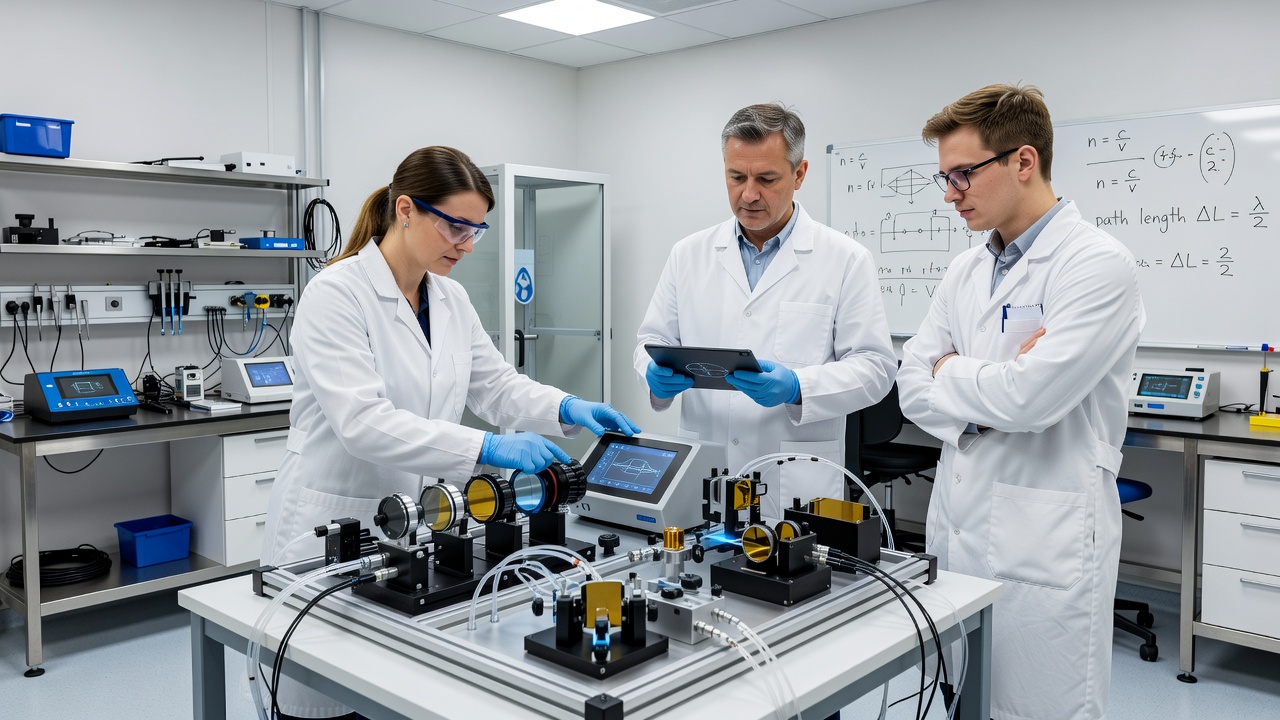
A research team from the Polish Institute of Photonics in Warsaw has developed and unveiled a novel tool for precise optical path measurements. This advancement marks a significant step forward in the field of optical path studies, offering researchers enhanced capabilities for accurate data collection in laboratory and field settings.
Tool Features and Development Process
The new measurement device employs cutting-edge interferometric techniques integrated with digital signal processing. It allows for measurements of optical paths in various media with an accuracy of up to 0.1 micrometers. The development involved extensive testing over two years, focusing on reducing errors caused by temperature fluctuations and vibrations. Team members collaborated with international experts to refine the algorithms used in the system. The tool is designed to be user-friendly, featuring an intuitive interface and automated calibration procedures. The device can handle both continuous and pulsed light sources, providing versatility for different experimental setups. Calibration is performed using standard reference materials to ensure reproducibility of results across different laboratories worldwide.
Funding for the project was provided by the Polish National Science Centre, highlighting the importance of government support for scientific innovation. Early adopters in academic institutions have reported positive results in experiments involving fiber optics and laser systems.
Future Impact on Research and Applications
Potential applications span multiple disciplines, including telecommunications for optimizing network performance, biomedical imaging for better diagnostic tools, and environmental monitoring for analyzing atmospheric light paths. The introduction of this tool is expected to accelerate research progress and enable new discoveries in how light travels through different substances. Industry partners are already expressing interest in commercial versions, which could lead to widespread use in manufacturing and quality control processes. Continued research will focus on miniaturization and enhancing portability for on-site measurements in challenging environments. Experts anticipate that this innovation will influence standards in optical metrology and foster further interdisciplinary collaborations.