Ines Griffin · 1 November 2026
Eastern European Research Teams Forge Connections Between Climate Data and Quantum Routing Simulations
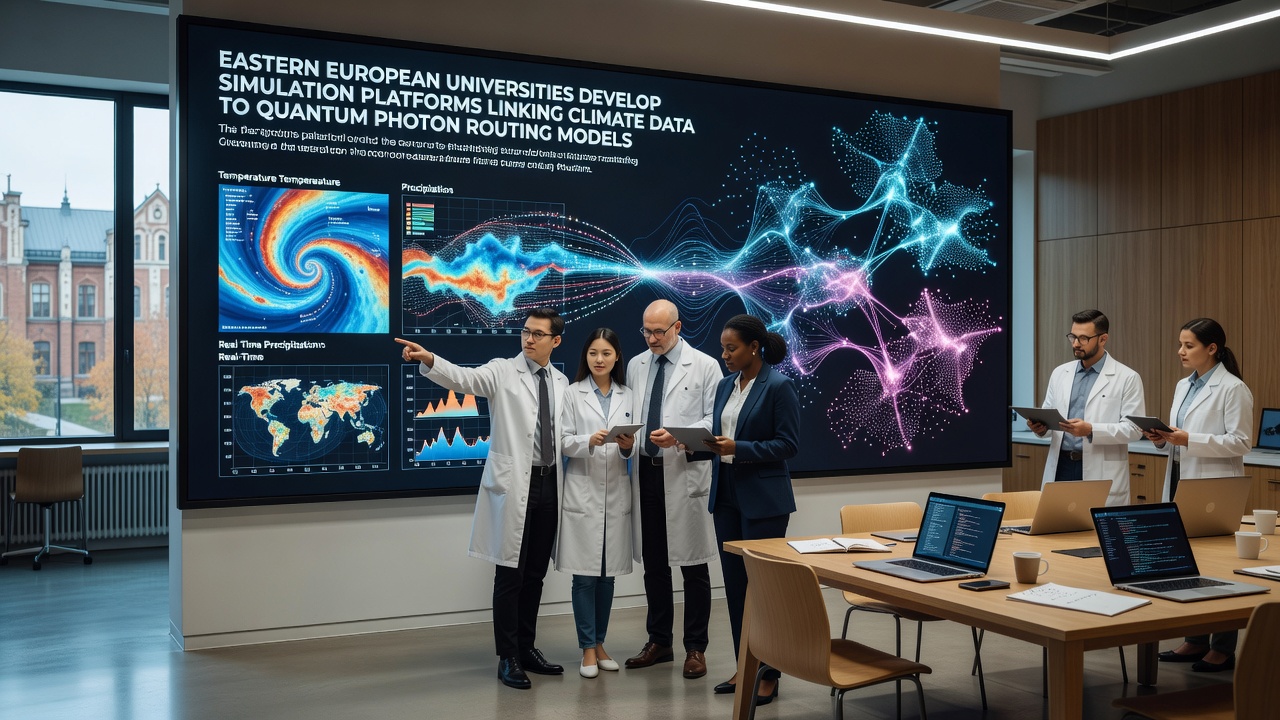
Academic networks spanning several Eastern European countries have begun rolling out simulation platforms that tie large-scale climate datasets directly to models of quantum photon routing, and these efforts have accelerated through coordinated projects involving multiple institutions since early 2025. Teams at universities in Poland, Hungary, Romania, and the Czech Republic share computational resources and observational records, while November 2026 marks the scheduled rollout of a unified testing phase across partner sites.
Platform Architecture and Data Integration
The core of each platform rests on modular software layers that ingest satellite-derived climate variables such as temperature gradients, humidity profiles, and aerosol concentrations, then feed those inputs into photon propagation algorithms that account for scattering and phase shifts along fiber and free-space channels. Developers structured the systems so that real-time weather feeds update routing predictions every fifteen minutes, and researchers adjust quantum channel parameters accordingly without interrupting ongoing simulations.
Engineers incorporated open-source quantum optics libraries alongside custom climate interpolation routines, which allows the platforms to handle both historical reanalysis data from 1990 onward and live sensor streams from regional meteorological networks. One case study at a Budapest-based group showed that incorporating seasonal aerosol spikes from agricultural burning improved photon loss estimates by 12 percent compared with static atmospheric models.
Regional Collaborations and Resource Sharing
Cross-border agreements established in 2024 now govern data access protocols and compute allocation, so institutions with stronger high-performance computing clusters handle the heaviest Monte Carlo runs while smaller groups focus on validation against local fiber testbeds. A joint working group meets monthly to align output formats, and participants exchange benchmark results that compare simulated bit-error rates against field measurements collected during documented weather events.
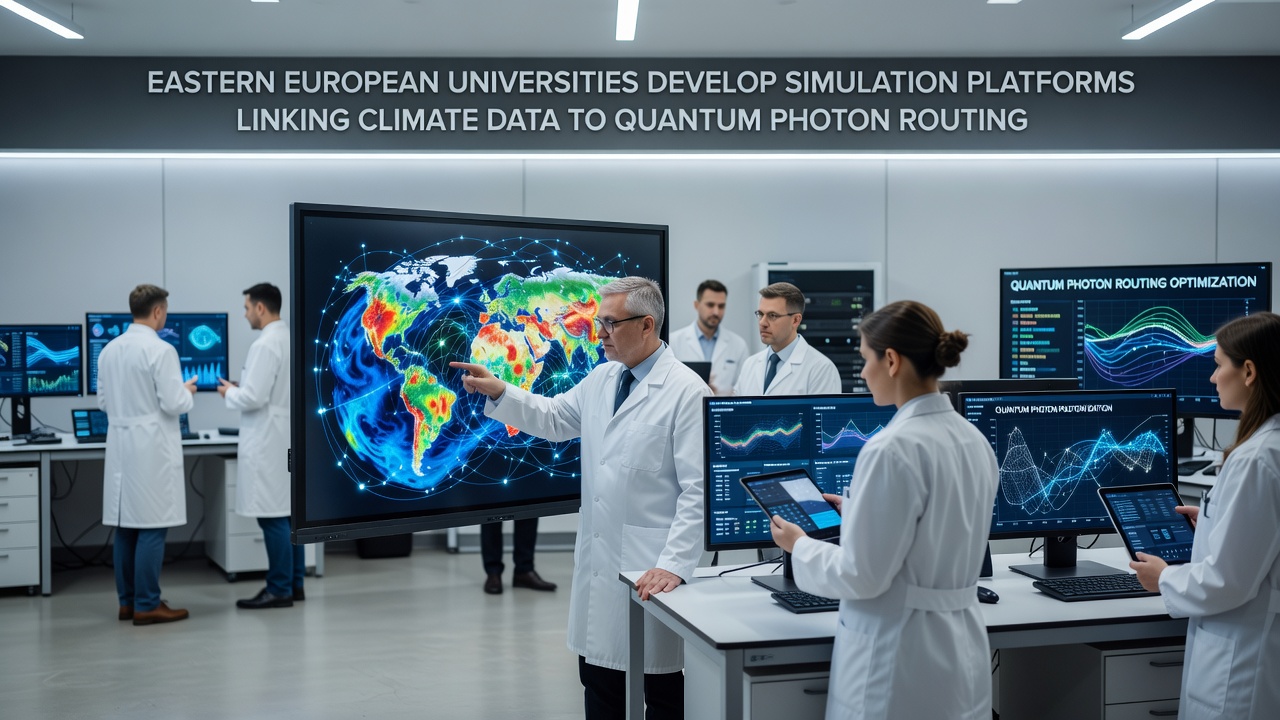
Funding streams from national science foundations and European structural programs support dedicated staff positions at each node, and observers note that this distributed model reduces duplication of effort while preserving institutional autonomy over specific research questions. Data from the platforms already appears in conference proceedings scheduled for late 2026, where teams plan to present comparisons of routing efficiency under projected 2035 climate scenarios versus current baselines.
Technical Challenges Addressed
Developers confronted mismatches between the spatial resolution of climate models and the meter-scale precision required for photon path calculations, so they introduced adaptive mesh refinement techniques that subdivide atmospheric layers near ground stations. Parallel processing pipelines now distribute these refined grids across GPU clusters, and early tests indicate that simulation runtimes dropped by roughly 40 percent after the refinement layer was added.
Another hurdle involved synchronizing time stamps between climate archives and quantum measurement logs, yet standardized UTC tagging combined with interpolation buffers resolved most discrepancies. Researchers at one Romanian site documented that residual timing offsets below 50 milliseconds produced negligible effects on final routing probabilities, which confirmed the robustness of the chosen alignment method.
Applications in Quantum Network Planning
Network designers use the platforms to evaluate candidate fiber routes under varying climate futures, and preliminary outputs suggest that certain east-west corridors may experience increased downtime windows during projected heatwave periods. Planners incorporate these windows into redundancy schedules, and the simulation outputs also inform wavelength selection strategies that mitigate dispersion changes tied to temperature fluctuations.
According to records released by the European Research Council, several ongoing grants explicitly reference these climate-quantum linkages as evaluation criteria for continued support. Separate documentation from the Institute of Physics highlights similar modeling approaches in related European initiatives, although the Eastern European implementations emphasize tighter coupling between live meteorological inputs and routing decisions.
Future Expansion Plans
Project leads have outlined steps to incorporate additional variables such as lightning-induced electromagnetic interference and permafrost thaw effects on buried cables, with prototype modules slated for integration before the November 2026 testing window. Expanded partnerships with Baltic and Balkan institutions are under discussion, and shared code repositories already host the initial module templates for those groups to adapt.
Conclusion
The simulation platforms developed across these Eastern European universities now provide a working bridge between climate science outputs and quantum photon routing requirements, and continued refinement through 2026 will determine how widely the approach spreads to other regions facing comparable infrastructure challenges.